.png?width=4800&height=3584&name=download(11).png)


What is the difference between a traditional raised bed and an elevated mobile garden bed like The Garden Bed?
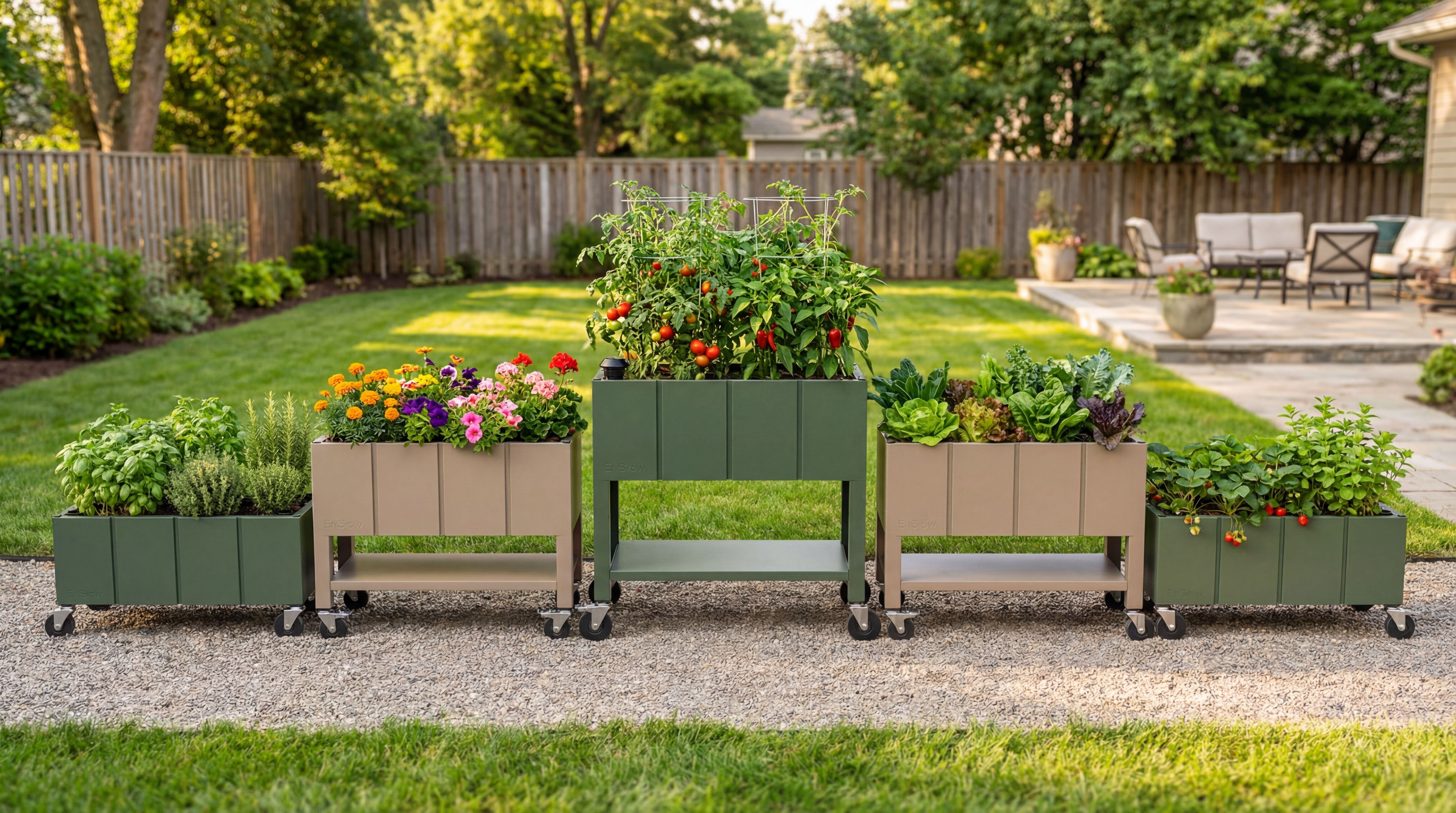
Traditional raised beds are bottomless frames built directly into the ground, making them permanent yard fixtures that require deep bending and kneeling to work with your plants. An elevated mobile bed, like The Garden Bed by EnGrow®, lifts the growing area to a comfortable waist height and includes heavy-duty wheels. This design allows you to easily move your garden to capture the best sunlight, protect it from bad weather, and grow fresh food on patios, balconies, or decks without any yard excavation or ground-pest hassles.
| Feature | Traditional Raised Bed | The Garden Bed by EnGrow® |
| Placement and flexibility | Permanent. Fixed to where they were built. Ample yard space required. Limited to areas with desired sun profile over the course of a day. | Highly mobile. Can be moved to chase sunlight, brought indoors for winter, or cleared for patio space. Perfect for when space is limited. |
| Physical Ergonomics |
Requires deep bending, kneeling, and heavy lifting near ground level. Can be hard to work in for even short periods of time. |
Multiple heights included through modular leg design. Waist-high at its tallest. Minimizes back strain and makes gardening accessible. |
|
Pest Protection |
Open to ground pests like moles, voles, slugs, and rabbits. |
Naturally elevated barrier. Keeps ground-dwelling pests completely out of your crop. |
|
Environmental Control |
Subject to native ground conditions, drainage issues, weeds, and poor soil ecosystems. Issues with native soil get passed on to the raised bed and your crop. | Self-contained ecosystem. Uses clean, controllable soil. Drainage is controlled and features active aeration. So, no soil compaction or water channeling. |
What is the difference between The Garden Bed by EnGrow® and other elevated, mobile garden beds?
When home gardeners upgrade from traditional in-ground plots to mobile elevated planters, they do so to solve a human problem: eliminating back strain, avoiding kneeling, and gaining the flexibility to move crops around a patio or balcony. However, while traditional elevated planters or typical "self-watering" beds make things easier for the gardener, they create a brand-new set of problems for the plants. Including severe soil compaction, nutrient leaching, and stagnant, oxygen-deprived pools of water that trigger destructive root rot.
The Garden Bed by EnGrow® stands alone as the only mobile growing system on the market engineered to solve both sides of the equation. It delivers the premium, waist-high ergonomics and effortless mobility that gardeners need, while simultaneously optimizing the biological environment that plants require to thrive.
By integrating our patented TrueSoil® Technology, EnGrow bridges the gap between human convenience and advanced plant biology. Review the breakdown below to see how our system outperforms conventional designs by actively aerating the root zone, protecting the living soil microbiome, and delivering a highly efficient, closed-loop ecosystem.
| The Garden Bed by EnGrow® | Standard Elevated "Self-Watering" Beds | Standard Open-Drainage Elevated Beds |
|
Aeration and Root Oxygenation Patented TrueSoil® Technology with built-in EcoTubes™ that continuously channel fresh oxygen directly into the root zone. |
Aeration and Root Oxygenation No internal airflow network; does not benefit from typical air exchange caused by top-watering plants. |
Aeration and Root Oxygenation No dedicated root aeration system; gravity causes soil to naturally compact over time, choking off root oxygen. |
|
Water and Drainage Control Features a structural Soil Platform that keeps soil fully separated from resting water with a drainage valve that fits any standard garden hose. Easily collect and reuse excess water. |
Water and Drainage Control Relies on bottom-up soil wicking. Don't have to manage water as closely. Base of soil stays overly saturated with water. Often lacks drainage valve. |
Water and Drainage Control Simple open holes or cloth liners. Water flows straight through completely uncontrolled. |
|
Soil Microbiome Health Maintains strict aerobic conditions, keeping beneficial living soil microbes alive while actively preventing root rot and pathogens. |
Soil Microbiome Health Prone to creating stagnant, oxygen-deprive anaerobic zones at the base of the soil, which breeds root rot and other negative biology that can harm your plant. |
Soil Microbiome Health Flushes out beneficial microbes and fluctuates wildly between bone-dry and oversaturated conditions. |
|
Nutrient Efficiency Supports closed-loop gardening by allowing you to easily drain, collect, and reuse nutrient-rich water collected from the chamber via the built-in drain. |
Nutrient Efficiency Cannot capture or recycle runoff; nutrients sit in stagnant water pools or leach away unevenly. |
Nutrient Efficiency Zero nutrient retention. Expensive amendments, and thus nutrients, wash straight out of the bottom holes or seems and are completely lost. |
|
Nutrient Efficiency Heavy-duty caster wheels paired with a premium, weather-resistant, food grade plastic built to last 20 years. |
Nutrient Efficiency Often made from wood that degrades over time, or from metal that absorbs significant heat in the summer. |
Nutrient Efficiency Commonly made from basic wood panels that can rot or thin metal that flexes and warps. |
What is TrueSoil® Technology and how does it actually work?
TrueSoil® Technology is the system present in every EnGrow® garden bed that helps keep living soil oxygenated and thriving. It consists of a few different individual features that all work together to achieve this goal. These include:
- The Soil Platform: A 2” tall platform with 176 evenly spaced holes in it that sits at the base of the garden bed. A specially cut piece of landscaping fabric sits on top of it, and the soil sits on top of the landscaping fabric. A chamber separated from the soil is created beneath the Soil Platform.
- EcoChamber™: This is the open-air chamber that is created beneath the soil by the Soil Platform. It acts as a collection basin for excess water, while also allowing oxygen to reach and penetrate the base of the soil.
- EcoTubes™: These 2” PVC tubes are located in each corner of the garden bed. They allow air to pass from the atmosphere, down into the EcoChamber™, and up through the soil.
- Drain Valve: The built-in valve at the bottom of the EcoChamber™. Any standard garden hose fits onto it, allowing you to collect any excess, nutrient-rich water, and reapply it to the same bed at a later time.
Oxygen, just like water and the nutrients in your soil, is a critical part of plant physiology. Without enough oxygen, roots can’t grow and the microbiology that supports them will begin to die. If you’d like a deeper understanding of the role of oxygen in plant growth, see our article on the Role of Oxygen in the Soil here (link coming soon!).
How does the EnGrow® Garden Bed prevent overwatering and root rot?

Over-watering is the leading case of plant failure. The Garden Bed eliminates this risk by utilizing the chamber created by the Soil Platform™ to collect excess water. When the soil becomes saturated, surplus water drains directly into this lower chamber instead of pooling at the root zone. Because the soil is completely isolated from standing water, it is physically impossible for the stagnant, oxygen-deprived conditions that cause root rot to form.
To manage this easily, we recommend keeping a ball valve adapter and hose permanently connected to the drain port. Whenever you water your garden, simply open the valve to let the excess drain out. This runoff is packed with valuable nutrients washed from your living soil; you can let it drain away naturally, or collect it to water and nourish other plants in your garden, creating a perfectly sustainable, closed-loop system.
How does this system support regenerative gardening and living soil?
Healthy plants rely entirely on a thriving soil microbiome. Traditional planter boxes and enclosed garden beds naturally suffer from soil compaction over time, which cuts off oxygen and suffocates the beneficial, living organisms your soil needs to stay fertile.
Our TrueSoil® Technology protects this ecosystem by maintaining constant, natural airflow through the root zone. By preserving these critical aerobic (oxygen-rich) conditions, it keeps beneficial soil microbes alive and active, allowing them to continuously break down organic matter and feed your plants.
Furthermore, when excess water filters through this living soil and collects in the base chamber, it carries away valuable organic compounds like humic acid. Draining and collecting this nutrient-dense runoff allows you to feed it back into your garden, recover valuable nutrients, and create a perfectly sustainable, closed-loop ecosystem.
What is the purpose of the EnGrow® Fan, do I need it, and when do I use it?
Short answer: no, you don’t need it. While TrueSoil® Technology provides exceptional passive aeration, the EnGrow® Fan takes your system to the next level. It slides into any of the four EcoTubes™ and once turned on, actively pushes fresh air into the EcoChamber™ and up through the base of the soil. The continuous active airflow gives your living soil and plant roots the ultimate boost, essentially supercharging all the benefits already provided by our TrueSoil® Technology.
We suggest running the fan for 10-15 minutes directly after watering to introduce oxygen back into the soil quickly. We don’t suggest running for much longer than that though, as it could dry out your soil unnecessarily if left on for long periods of time.
Can The Garden Bed be used both indoors and outdoors?
Yes. Its clean, durable construction is completely self-contained to prevent messy leaks, making it perfect for outdoor patios, balconies, and decks, as well as indoor growing environments. The single-injection soil tub means the bed will never leak. Grow in a tent, in your garage, or even inside your home stress-free. Our garden beds maintain optimal soil conditions and allows you to harvest incredibly healthy plants regardless of your available space.
What soil should I put in The Garden Bed to maximize my Garden?


The ideal garden bed soil requires a balanced soil composition—specifically a loose, loamy texture that offers both excellent aeration (so roots can breathe) and superior moisture management to prevent root rot while retaining adequate water. To fuel robust plant growth, your mix must contain ample nutrients derived from organic matter, ensuring a steady, slow-release supply of essential macro and micronutrients. Crucially, a high-quality garden soil must possess a strong Cation Exchange Capacity (CEC); this chemical property measures the soil's ability to hold onto vital nutrient ions (like calcium, magnesium, and potassium) and prevent them from washing away during heavy watering.
For us, the most successful soil we have ever used comes from KIS Organics. All of their soils come pre-packed with all the nutrients your plant will need for the entire growing cycle. They’re even certified as a fertilizer due to all of the beneficial additives. You can visit their site at www.kisorganics.com for our favorite soil and a number of ethically sourced amendments.
What is “true living organic soil” and why should I use it in my bed?
True living organic soil is a biologically active ecosystem teeming with beneficial microbes, mycorrhizal fungi, protozoa, and beneficial bacteria. Instead of feeding the plant directly with synthetic chemical fertilizers, you feed the soil. This subterranean food web breaks down organic matter into slow-release, plant-available nutrients while naturally building soil structure, maximizing Cation Exchange Capacity (CEC), and building systemic plant immunity.
The beneficial microbes, fungi, and earthworms that make living soil "alive" are strictly aerobic. Which means they require oxygen to survive and work. Without proper airflow, soil becomes compacted and anaerobic, killing off your beneficial biology and inviting harmful pathogen strains. The constant air exchange provided by EnGrow’s Eco-Chamber™ ensures your subterranean ecosystem stays fully oxygenated, keeping your microbial workforce active and healthy.
Do I need to replace my soil every year when using a living organic ecosystem?
Not at all! Unlike traditional potting soils with their synthetic nutrients that need to be tossed at the end of a growing cycle, a true living organic soil actually improves over time. Because The Garden Bed protects your soil structure from compaction and root-binding, you can reuse it indefinitely. You simply top-dress the bed with fresh organic compost, worm castings, and organic amendments between planting seasons to re-fuel the biological cycle.
There are different levels of precision you can get regarding amending a soil in between growing seasons. For most people, you can simply apply an organic nutrient pack at the rate outlined on the pack itself. We suggest KIS Organics nutrient pack, as all the nutrients are organic and ethically sourced. You can find it here.
Can I use regular backyard dirt to fill my elevated garden bed?
We highly advise against using straight backyard clay or dirt. Native ground soil is usually too heavy, dense, and prone to severe compaction when placed into an elevated container, which cuts off oxygen. For an elevated environment, start with a premium mix of 50% clean topsoil, 30% organic compost (to kickstart your living biology), and 20% aerating aggregates like perlite or coarse sand. Or purchase a soil that has good structure and holds ample nutrients for the growing season.